
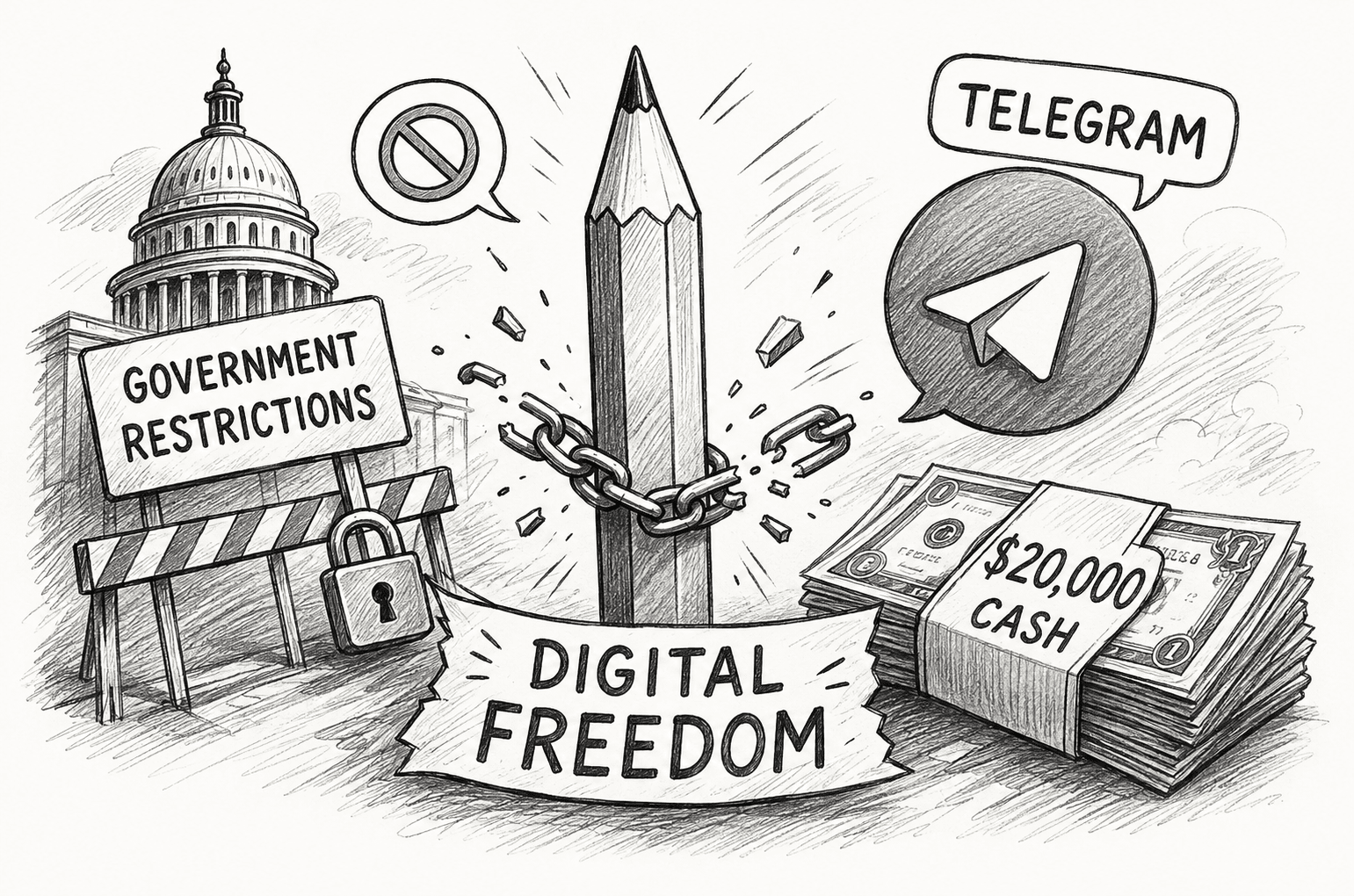
Pavel Durov is putting $200,000 behind Digital Freedom — and content creators are invited. Here's what Telegram's biggest contest says about the war on social media.
Pavel Durov doesn't just fight governments in court. Now he's crowdsourcing the resistance.
On June 15, the billionaire founder of Telegram took to X with an announcement that's equal parts marketing genius and ideological manifesto: a $200,000 content creator contest built around a single flag — Digital Freedom.
The mechanic is simple. Post a video. Hit 10,000+ organic views. Get a cut of the prize pool. The content doesn't even have to mention Telegram.
That last part matters more than it sounds.
If you've been following Telegram's story, there's a through-line you can't ignore. Every few years, some government tries to kill the platform. And every single time, Telegram survives — sometimes more popular than before.
The most famous example: Russia. In 2018, the Russian government blocked access to Telegram entirely. Durov's response at the time was essentially a shrug. His response now, referencing that same ban in a speech at the Oslo Freedom Forum, was more pointed:
"When the Russian government banned Telegram, 95% of Russian teenagers kept using it. They just moved to VPNs."
The ban didn't work. It never works. And Durov knows this better than anyone — because he's watched it play out in real time, across multiple countries, multiple times.
The immediate trigger for the contest appears to be the UK government's push to ban social media for children under 16. Durov isn't having it.
In his Oslo Freedom Forum speech, he framed the moment with a Titanic analogy: "We've hit an iceberg. We have no life jackets. And we have no idea we're at this point." The comparison isn't subtle — governments steering the ship of digital policy straight into disaster while passengers celebrate on deck.
His core argument: "child protection" is a pretext. Behind closed doors, he says, what governments actually want is control over public discourse on the platforms that shape it. He pointed to the European Commission requesting access to encrypted messages sent on platforms like Telegram as exhibit A — the same "child protection" framing, the same surveillance infrastructure underneath.
It's a position that will make a lot of people uncomfortable. It's also not an argument without evidence.
When Durov announced the $200,000 prize on X, the replies were predictably cynical. One comment read: "Watch half of X become Telegram marketers."
Durov responded directly: "This isn't about 'Telegram marketers' — the videos don't have to mention Telegram."
That's the tell. This isn't a growth hack for downloads. It's an attempt to fund a distributed media campaign around an idea — digital freedom as a value worth defending publicly. Durov wants creators to carry that argument into their audiences, in their own voice, in their own format, without the Telegram logo stamped on top.
Whether that works is a different question. But it's a smarter play than a referral program.
The contest is a data point in something bigger. Tech founders are increasingly building their own media operations — not as PR, but as actual ideological infrastructure. Durov isn't just running a messaging app. He's running a worldview, and he's now paying creators to distribute it.
You can agree or disagree with his politics. But the strategic logic is hard to argue with: if governments are going to use media narratives to justify platform restrictions, platforms will fund counter-narratives in return.
The $200,000 is small by any institutional standard. The idea it's backing is not.
Telegram's contest is live. The threshold is 10,000+ organic views. The topic, officially, is Digital Freedom — however you want to interpret that.